Keep Scrolling for More Images!
From America's #1 Safety Banner Company
• The Most Trusted Name in Industrial Safety Banners
Humans in USA Support email: This email address is being protected from spambots. You need JavaScript enabled to view it..
Humans in USA Phone Support: (901) 321-8374
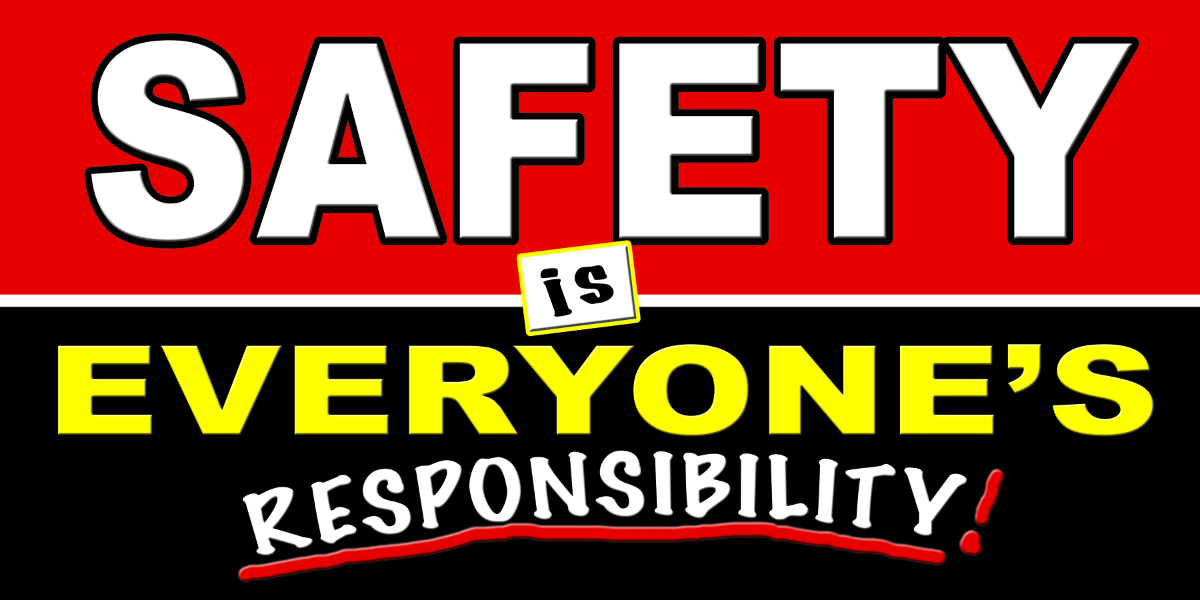 Designed by SafetyBanners.Org in 2008
This Safety Banner Is The Most Copied Industrial Safety Banner in the World.
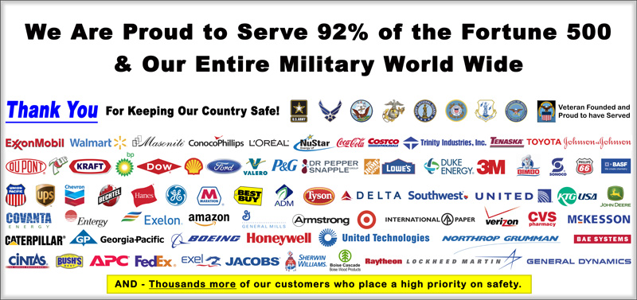 • ONLY SafetyBanners.Org has ALL of These Capabilities
• Largest Selection, Including Spanish Language
• The Most Options for price, size & materials PLUS horizontal & vertical format.
• The Highest Quality safety banners.
• The Greatest Customization capability.
• Fast Delivery
• Low Cost
• 100% Satisfaction Guaranteed, no questions asked.
• 100% American Made in Tennessee.
Only from SafetyBanners.Org & Safety Banners USA
-----------------------------------------------------------------------------------------------------------------------------------
The 34 Product Categories on your left are extremely helpful to safety banner buyers.
Our 34 safety banner categories are:
• Our Most Popular Safety Banners
• New banners
• General Safety Awareness
• Attitude and Teamwork
• Cell Phone Use
• Christmas and Fall
• Driving Safely
• Ergonomics
• Eye Protection
• Family Series
• Fire Safety
• Flu & Covid Prevention
• Forklift Safety
• Green Banners
• Hand Safety
• Hearing Protection
• Heat Stress and Heat Stroke
• Housekeeping
• Jet Lovers
• Lifting Safety
• Lock Out Tag Out
• Nature and Outdoors
• Oil refinery turnaround
• PPE Collection
• Quality Series
• Safety Series
• Spring safety
• Slips, Trips & Falls
• Spanish & Bilingual
• Thank You
• Troop support
• VPP collection
• Winter Series
•Translation to Spanish
• Custom safety banners
Safety Banners for Attitude and Teamwork in American industry.
Safety Banners built in Memphis, Tennessee USA.
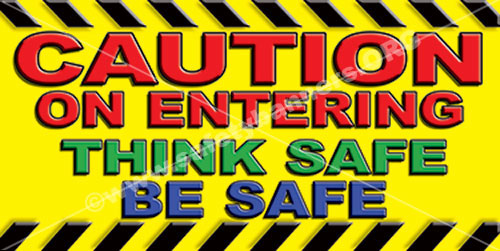 Our Safety Banners encouraging Attitude and Teamwork are used by most of the Fortune 500 companies!
A good attitude and employee teamwork are important in American industry! Safety Banners can help.
Good Attitude and worker Teamwork can help improve safety and quality.
Researchers have identified 10 teamwork processes that fall into three categories:
Transition processes (between periods of action) Mission analysis
Goal specification
Strategy formulation
CLICK HERE for our NEW safety store, Safety Banners USA (safetybannersUSA.com)
 Action processes (when the team attempts to accomplish its goals and objectives) Monitoring progress toward goals
Systems monitoring
Team monitoring and backup behavior
Coordination
Interpersonal processes (present in both action periods and transition periods) Conflict management
Motivation and confidence building
Affect management
 Researchers have confirmed that performing teamwork works better when you are with a close person. This is due to a chemical called serotonin Hydroxytryptamine which helps an individual to communicate better and think more positively which. Serotonin is produced when an individual is in a situation where he/she is in comfortable environment. Sometime it just doesn't workWhat does this mean?
Training to improve teamwork
As in a 2008 review, "team training promotes teamwork and enhances team performance". In specific, an analysis of several published and unpublished studies concluded that team training is "useful for improving cognitive outcomes, affective outcomes, teamwork processes, and performance outcomes.
Benefits
Problems solving: A single brain can’t bounce different ideas off of each other. Each team member has a responsibility to contribute equally and offer their unique perspective on a problem to arrive at the best possible solution. Teamwork can lead to better decisions, products, or services. The quality of teamwork may be measured by analyzing the following six components of collaboration among team members: communication, coordination, balance of member contributions, mutual support, effort, and cohesion. In one study, teamwork quality as measured in this manner correlated with team performance in the areas of effectiveness (i.e., producing high quality work) and efficiency (i.e., meeting schedules and budgets). A recent analysis also found a relationship between teamwork and team effectiveness.
 Healthy competition: A healthy competition in groups can be used to motivate individuals and help the team excel.
Developing relationships: A team that continues to work together will eventually develop an increased level of bonding. This can help people avoid unnecessary conflicts since they have become well acquainted with each other through team work. Team members’ ratings of their satisfaction with a team is correlated with the level of teamwork processes present.
Everyone has unique qualities: Every team member can offer their unique knowledge and ability to help improve other team members. Through teamwork the sharing of these qualities will allow team members to be more productive in the future.
 Attitude: Daniel Katz classified attitudes into four different groups based on their functions
Utilitarian: provides us with general approach or avoidance tendencies
Knowledge: help people organize and interpret new information
Ego-defensive: attitudes can help people protect their self-esteem
Value-expressive: used to express central values or beliefs
Utilitarian People adopt attitudes that are rewarding and that help them avoid punishment. In other words any attitude that is adopted in a person's own self-interest is considered to serve a utilitarian function. Consider you have a condo, people with condos pay property taxes, and as a result you don't want to pay more taxes. If those factors lead to your attitude that " Increases in property taxes are bad" you attitude is serving a utilitarian function.
Knowledge People need to maintain an organized, meaningful, and stable view of the world. That being said important values and general principles can provide a framework for our knowledge. Attitudes achieve this goal by making things fit together and make sense. Example:
I believe that I am a good person.
I believe that good things happen to good people.
Something bad happens to Bob.
So I believe Bob must not be a good person.
 Ego-Defensive This function involves psychoanalytic principles where people use defense mechanisms to protect themselves from psychological harm. Mechanisms include:
Denial
Repression
Projection
Rationalization
The ego-defensive notion correlates nicely with Downward Comparison Theory which holds the view that derogating a less fortunate other increases our own subjective well-being. We are more likely to use the ego-defensive function when we suffer a frustration or misfortune.
Value-Expressive
Serves to express one's central values and self-concept.
Central values tend to establish our identity and gain us social approval thereby showing us who we are, and what we stand for.
SafetyBanners.Org
1657 Shelby Oaks Drive N.
Memphis, TN 38134
Serving American industry since 1995
SAFETY Banners from America's Largest Supplier of Safety Awareness Banners
 SAFETY from America's Largest Supplier of Safety Awareness Banners Safety can improve company moral as well as help reduce cost. Safety awareness can be enhanced with safety banners.
Safety is a relative term. Safety in the workplace can be both a morale booster and save company money. Several studies have shown that when a company makes safety a priority, employee productivity goes up, morale goes up and total cost goes down. Management discussing Safety and Health Topics with employees enforces a companies’ commitment to keeping it’s workers safe and healthy on the job.
CLICK HERE for our NEW safety store, Safety Banners USA (safetybannersUSA.com)Complete assessments to determine performance gaps and improvement opportunities in your Safety Management System. This will help you to evolve a framework of safety processes and procedures that help your company to achieve its safety objectives, and integrate safety in the business.
 Companies should use employee surveys to understand and improve Safety Leadership and Employee Engagement. Working to improve this shared ownership and responsibility will enhance your safety culture.
Continue risk reduction through a repeated process focused on operational risk and how to make worker jobs safer. Whether the problem is overexertion, slips, trips or falls, we can help you to understand risk and how to reduce it. Safety is a 24/7 proposition.
Use benchmarking and performance measurement to see how you safety efforts compare to your peer groups, how you have improved, and what gaps you have to close. Data strategies that allow for safety benchmarking, measuring improvement over baseline and predictive, prescriptive modeling Improving work safety is a topic, and a goal, that should be on everyone’s mind.
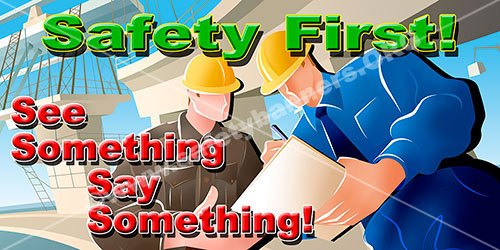 According to the US Department of Labor, every year almost 6000 people are fatally injured at work. More than four million more people suffer non-fatal injuries, including over a million of which cause them to miss one or more days of work. What’s even worse than the bare statistics is that a great many of these deaths and injuries were due to carelessness and negligence, improper safety procedures and could have easily been avoided by paying more attention to safety guidelines.
Employers are required to provide a safe workplace, but ultimately your safety at work is your own responsibility. If you feel like your environmentis unsafe and your complaints fall on deaf ears, you should look for employment elsewhere. Of course, some jobs and industries are inherently more hazardous than others and if you have one of these jobs, you’ll need to be extra vigilant. Deaths and injuries occur in all kinds of e
mployment sectors and job descriptions, however – factories, construction, office work, farming, information technology, etc. The lack of work safety is a big problem and we should do everything we can to reduce the number of deaths and injuries at work.
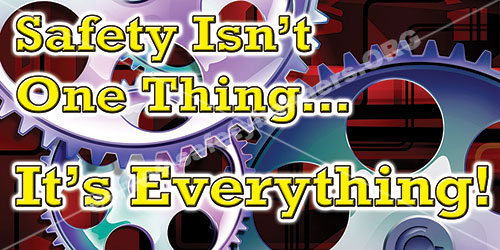 Thankfully, there are a great many things you can do to improve your own personal safety at work. You can also create an atmosphere of safety awareness among your coworkers and supervisors, as well as lobby your employer to improve safety policies, practices, and training. Be pro-active when it comes to workplace safety. Don’t wait for others to pick up the ball. While you’re waiting, you may wind up getting injured. So take it upon yourself to do what you can to improve your own workplace safety.
Safety must be kept visible and present in the company workplace at all times. Safety banners are a very effective way to keep workers focused on safety while at work.
SafetyBanners.Org
1657 Shelby Oaks Drive N.
Memphis, TN 38134
Serving American industry since 1995